


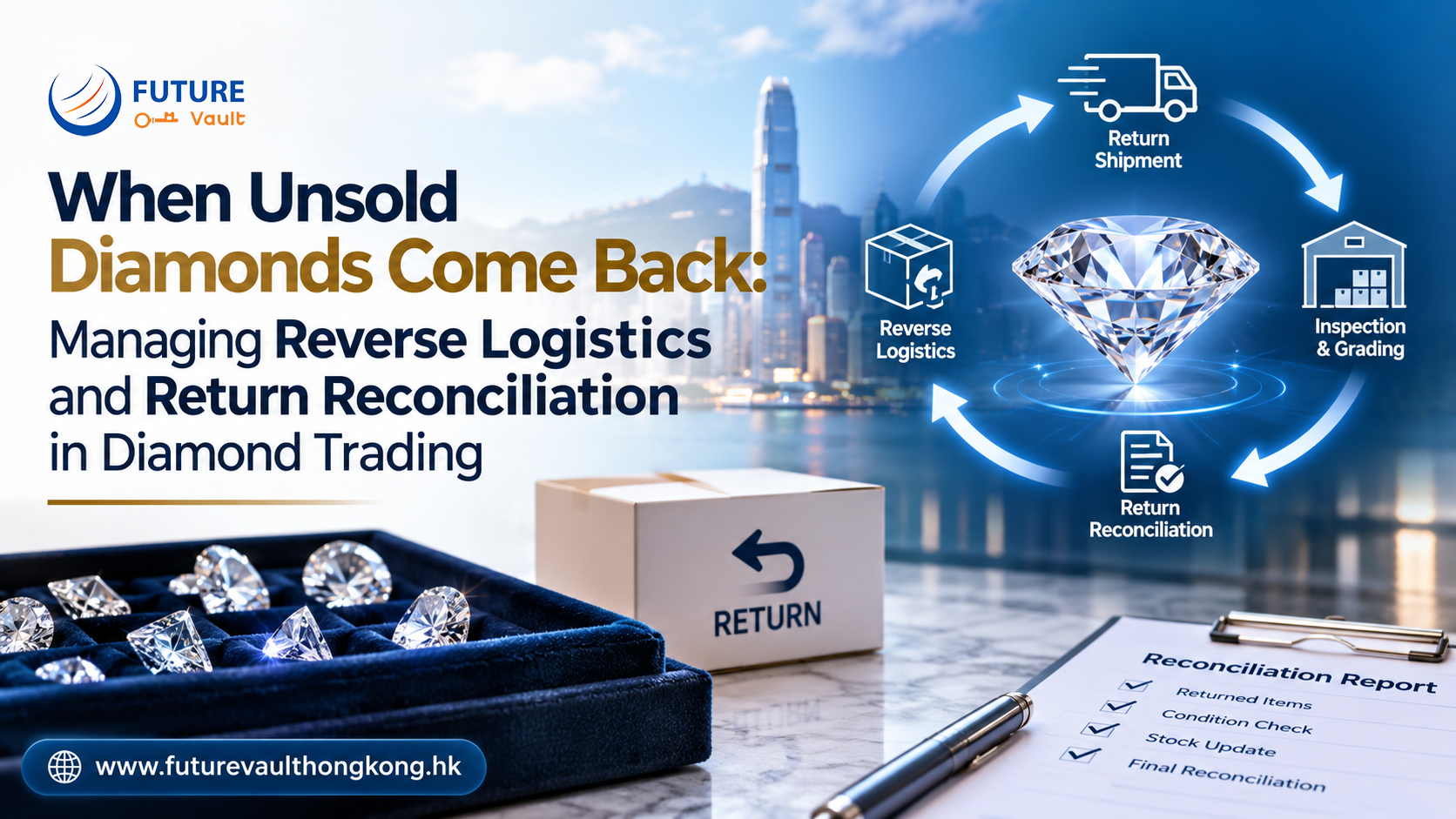
Diamond trading does not end when a consignment leaves the vault or reaches a potential buyer. In many transactions, diamonds are sent to retailers, wholesalers, manufacturers, dealers or other business partners for evaluation and sale. However, not every consignment results in a completed purchase. Some parcels are sold partially, some remain unsold, and others are returned because the buyer's requirements have changed.
This creates an important operational responsibility for diamond trading businesses: managing the safe and accurate return of unsold inventory.
Returned parcels must be collected, transported, received, verified, matched with their original records and properly updated in the inventory system. Any gap in this process can create confusion around stock availability, outstanding memos, transaction status and inventory valuation.
This is where reverse logistics in diamond trading and diamond return reconciliation become essential. A structured return management process helps businesses maintain better control over valuable inventory and manage the complete diamond consignment lifecycle.
For diamond wholesalers, retailers and trading institutions in Hong Kong, connecting diamond pickup and delivery services, secure diamond vault storage and diamond inventory and business process management can support a more organized approach to handling returned consignments.
1. Understanding Reverse Logistics in the Diamond Trading Industry
In conventional logistics, products move from a seller or warehouse towards a buyer or distribution point. Reverse logistics describes the movement of goods in the opposite direction, from the receiving party back to the seller, supplier or designated storage facility.
In diamond trading, this process has additional requirements because consignments may contain high-value stones with different weights, shapes, cuts, colours, clarities and identification references.
Diamond reverse logistics involves more than arranging a return delivery. It includes coordinating collection, maintaining consignment references, receiving returned parcels, checking supporting documentation, verifying inventory and updating the associated transaction records.
A typical return may involve:
- Identifying diamonds that remain unsold after a buyer evaluation or selling period.
- Confirming which items are being returned and which have been purchased.
- Arranging secure diamond pickup and delivery.
- Matching the returned parcel with its original dispatch and memo details.
- Verifying the received inventory against documented specifications.
- Updating stock records and return status.
- Moving verified inventory into an appropriate diamond vault storage or next-order workflow.
Each stage should be connected through clear records so that the business can understand where a consignment has been, what happened to it and what its current status is.
1.1 Why Returned Diamond Consignments Need a Separate Management Process
Returned diamonds should not automatically be treated as regular available stock. Before being made available for another order, the returned parcel needs to pass through a controlled receiving and verification process.
Consider a wholesaler who sends several diamond lots to different buyers. One buyer may return the entire parcel, another may purchase some stones and return the balance, while a third may request additional time for evaluation.
If these situations are recorded without a consistent process, the wholesaler may struggle to identify which consignments have been returned, which orders are still awaiting a return, which parcels contain partially sold inventory and which memo records remain outstanding.
A dedicated diamond return management process helps prevent these records from becoming disconnected. Businesses can also use organized diamond trading business process management to coordinate related operational activities.
2. Why Unsold Diamond Returns Can Create Operational Challenges
The return of an unsold diamond parcel may appear to be straightforward, but several operational details must be managed correctly. These challenges become more noticeable when a business handles multiple consignments, buyers and daily transactions.
2.1 Difficulty Matching Returned Parcels with Original Consignment Records
Every outbound diamond consignment should have identifiable records containing relevant parcel references, lot information, quantities, weights and buyer or recipient details.
When a parcel returns, these details must be compared with the original dispatch information.
Without proper diamond consignment tracking, employees may spend additional time identifying the original transaction, locating supporting documents and confirming which inventory records need to be updated.
Unique lot references and consistent documentation make it easier to connect the return with its original movement. Organized inventory management and reconciliation also help maintain consistency between physical stock and business records.
2.2 Partial Returns and Mixed Sales
Not every diamond consignment returns as a complete parcel. A buyer may purchase selected stones and return the remaining items.
For example, a trader may send a parcel containing 25 individual stones. The buyer purchases 10 stones and returns the remaining 15. The returned items must be reconciled against the original consignment rather than being recorded as an entirely new parcel.
This requires accurate partial diamond return management, including:
- Recording the quantity originally dispatched.
- Identifying the items sold or retained by the buyer.
- Recording the quantity physically returned.
- Comparing returned specifications with the original lot details.
- Updating the remaining inventory balance.
- Maintaining the correct status of the original transaction.
Without this distinction, businesses may face incorrect stock balances or confusion about which items remain available.
2.3 Delays in Memo Closure and Transaction Updates
A diamond memo generally records details relating to a consignment provided to a buyer or business partner. Depending on the business arrangement, the memo may contain information about the parties involved, parcel identification, stone specifications, quantities, weights and relevant transaction terms.
When diamonds return, the corresponding diamond memo return process must also be updated. If the physical parcel has returned but the memo status remains outstanding, the business may have difficulty understanding the actual position of its inventory and transactions.
Proper diamond memo creation and management helps connect the physical movement of diamonds with the related business records.
2.4 Differences Between Expected and Received Inventory
A returned parcel should be checked against its original dispatch details. Differences may arise because of incomplete documentation, recording mistakes, partial sales, parcel identification issues or other operational circumstances.
A difference should not automatically be treated as a loss or discrepancy without investigation. It should be documented, reviewed and resolved through the business's established verification process.
Consistent diamond inventory verification and return reconciliation help identify such differences before the returned stock is made available for another transaction.
3. The Complete Diamond Return Management Workflow
An organized return workflow connects the buyer, logistics team, receiving facility, inventory records and transaction documentation. Each stage should have a clear responsibility and an identifiable record.
Step 1: Identify the Unsold Diamond Consignment
The process begins when a buyer or recipient confirms that certain diamonds have not been purchased and need to be returned.
The business should identify the original consignment using the available memo number, lot reference, buyer details, dispatch record and parcel information.
At this stage, establish the original consignment reference, buyer details, quantity and weight dispatched, quantity being returned, return type and expected collection information.
Step 2: Arrange Secure Diamond Pickup and Return Transportation
Once the return is confirmed, the next responsibility is arranging the physical movement of the diamonds.
Because diamond consignments are high-value assets, businesses should use an appropriate logistics arrangement based on the consignment, route, destination and applicable handling requirements.
A documented diamond pickup and delivery process can help coordinate collection from the buyer, outlet, business location or other designated point and movement towards the receiving facility.
Important coordination details may include collection location, authorized contact person, consignment reference, scheduled pickup, handover documentation, delivery destination and receipt confirmation.
Businesses looking for organized diamond consignment transportation can explore Future Vault's Diamond In-Transit / Pickup & Delivery Services.
This service is particularly relevant when diamond parcels need to move between trading locations and designated facilities as part of regular business operations.
Step 3: Receive and Identify the Returned Parcel
When the returned consignment reaches the designated receiving facility, it should be identified before inventory records are updated.
The receiving team should compare the parcel's available identification details with the expected return information.
Receiving checks may include parcel or lot reference, packaging condition, available seals, sender and recipient details, accompanying documents and date and time of receipt.
If a parcel appears inconsistent with the expected return information, the issue should be recorded and escalated according to the organization's verification procedure.
Step 4: Verify Diamond Quantity, Weight and Specifications
Parcel identification is only one part of the return process. The next step is comparing the returned diamonds with the original inventory details.
Depending on the consignment records and business requirements, the verification process may involve counting the returned stones, checking individual or lot-based carat weight, reviewing shape and cut information, comparing colour and clarity details where recorded, and checking available identification references.
This stage is particularly important for diamond inventory management, because incorrect quantity or weight information can affect future orders, sales records and inventory reports.
For related inventory counting, sorting and management requirements, explore Future Vault's Diamond Trading Business Processing Services.
Step 5: Match the Return with the Original Diamond Memo
After the returned inventory has been identified and checked, the corresponding memo records should be reviewed.
The original memo provides a reference for understanding what was sent, to whom it was sent and what has happened to the consignment.
The return record should be connected with the original memo number, buyer details, original parcel references, dispatched quantity and weight, returned quantity and weight, items sold or retained, and outstanding transaction details.
This is an essential part of diamond memo reconciliation. It helps the business distinguish between completed sales, outstanding consignments, partial returns and fully returned parcels.
To learn more about related memo creation, memo management and reconciliation support, visit Diamond Trading Business Process Management.
Step 6: Update Diamond Inventory and Return Status
Once the required verification is complete, inventory records should be updated to reflect the actual returned stock.
A structured diamond inventory update process may include recording the verified returned quantity, updating carat weight, linking stock with its original lot reference, recording partial or complete return status, updating memo details and identifying items that require additional verification.
Only inventory that has completed the required checks should be moved into the appropriate available-stock category.
For related diamond inventory management and vault storage services, businesses can explore Future Vault's dedicated service page.
Step 7: Complete Return Reconciliation and Close the Transaction
The final stage is to compare the original consignment information with the return, sales and inventory records.
Diamond return reconciliation should establish whether the original consignment has been fully accounted for.
For example, if 25 stones were originally dispatched, 10 were purchased and 15 were returned, the records should clearly reflect all three quantities.
The business should also review outstanding transaction details, payment records, memo status and unresolved differences before treating the process as complete.
Related reconciliation, sales and purchase management and accounting support can be explored through Future Vault's Diamond Trading Business Process Management Services.
4. How Partial Diamond Returns Should Be Managed
Partial returns deserve special attention because the original consignment is divided between sold inventory and returned inventory.
If the business records only the overall consignment as returned or completed, it may lose important information about the individual items involved.
4.1 Maintain the Original Lot Reference
Returned stones should remain connected to the original lot or consignment reference wherever possible. This makes it easier to trace the movement of the original parcel and understand how its quantity has changed.
4.2 Separate Sold and Returned Quantities
The inventory record should distinguish between items purchased by the buyer and items physically returned.
For example:
- Original quantity dispatched: 25 stones.
- Quantity purchased: 10 stones.
- Quantity returned: 15 stones.
- Outstanding quantity: 0 stones, subject to verification.
This type of partial consignment reconciliation helps ensure that the remaining stock is correctly represented.
4.3 Track Each Return Against Its Original Transaction
If a buyer returns items in multiple batches, each return should have its own receiving record while remaining linked to the original transaction.
This is particularly useful for diamond businesses that handle multiple parcels and buyers simultaneously.
Consistent inventory and memo records can be supported through diamond trading business process management.
5. The Importance of Diamond Memo Management in Return Reconciliation
A memo is an important record in many diamond trading arrangements. It helps businesses maintain information about consignments provided to buyers or business partners.
However, the usefulness of a memo depends on whether its status is updated when the physical inventory moves.
5.1 Connecting Physical Inventory with Memo Records
The original memo should be linked with the actual returned parcel and its verification record. This creates a connection between original consignment documentation, buyer details, dispatch records, return collection details, verified inventory and sales information.
This connection supports better diamond consignment management and reduces the possibility of disconnected operational records.
5.2 Managing Open, Partially Returned and Closed Memos
A business may have several memo situations at the same time. Some consignments may still be with buyers, some may have been partially returned and others may be completely reconciled.
A consistent status structure can help teams distinguish between:
- Open Memo: The consignment is still outstanding.
- Partially Returned: Some items have returned while other items have been sold or remain outstanding.
- Return Under Verification: The parcel has been received but the required checks are not complete.
- Fully Returned: The expected inventory has been received and verified.
- Closed: The relevant inventory and transaction records have been reconciled according to the business process.
These are suggested operational status categories. Businesses can adapt them to their existing accounting and memo systems.
For professional support with diamond memo creation and management, inventory records and reconciliation, visit Future Vault's Business Processing Services.
6. Secure Diamond Logistics: Why the Return Journey Matters as Much as the Outbound Journey
Diamond consignments can move between offices, buyers, retailers, trading facilities and designated storage locations. Each movement should be planned according to the value and handling requirements of the goods.
Businesses sometimes focus heavily on the security of outbound shipments while treating returned parcels as routine deliveries. This can create unnecessary gaps in their handling procedures.
6.1 Documented Pickup and Delivery Coordination
A clearly coordinated pickup and delivery arrangement helps businesses know where a returned consignment is expected to be collected and delivered.
Important information includes collection instructions, parcel identification, authorized contacts, destination details and delivery confirmation.
Businesses that regularly move diamond consignments between trading locations can benefit from an organized diamond in-transit service and documented handover process.
Explore Diamond In-Transit / Pickup & Delivery Services by Future Vault for more information about diamond consignment movement.
6.2 Maintain Clear Handover Records
Each handover should be supported by the relevant consignment reference and receiving information.
Businesses should maintain a clear record of who authorized the collection, which parcel was handed over, where it was sent and who acknowledged its receipt.
This supports better diamond consignment tracking and makes it easier to investigate questions about a particular shipment.
6.3 Plan the Destination Before Collection
A returned parcel should have a clearly identified destination before collection is arranged.
Depending on the business requirement, the parcel may need to be delivered to the trader's office, a designated receiving facility or an appropriate secure diamond vault storage facility.
Coordinating the destination in advance helps avoid unnecessary movement and delays between collection and inventory verification.
7. The Role of Secure Diamond Vault Storage After a Return
Once a returned parcel has been received and the required verification has been completed, the next question is where the inventory should be held.
Leaving valuable diamonds in an unstructured holding arrangement can create avoidable handling and record-management challenges.
Secure diamond vault storage provides a designated environment for holding diamond inventory while it awaits the next order, sale, inspection or business decision.
7.1 Organizing Returned Inventory in a Secure Storage Facility
Returned lots should be identifiable through their relevant inventory and consignment references.
A structured storage process can help businesses distinguish between newly deposited inventory, returned and verified lots, inventory awaiting additional verification, stock reserved for confirmed orders and consignments awaiting further instructions.
Clear identification makes it easier to locate and manage inventory when a new order is received.
7.2 Maintaining Inventory Visibility During Storage
Secure storage and inventory visibility should work together. Businesses need to know not only where their diamonds are stored but also which records are associated with each lot.
A well-organized diamond vault and locker service can support the management of stored inventory and provide a designated facility for diamond trading operations.
Explore Future Vault's Diamond Vault / Locker Services for information about secure diamond storage, lot-based deposit processing and inventory management.
8. Diamond Inventory Management: Making Returned Stock Ready for the Next Transaction
The return process is not complete simply because the parcel has reached the business. The inventory must also be correctly recorded and made available for future operations according to the required verification and approval procedures.
This is where effective diamond inventory management becomes important.
8.1 Counting and Sorting Returned Diamonds
Counting and sorting help businesses establish what has physically returned and how the items should be organized.
Depending on the nature of the consignment, inventory records may include number of returned stones, carat weight, shape, cut, colour and clarity information where available, parcel references, return date and current inventory status.
Proper diamond counting and sorting services help businesses maintain organized stock records and prepare returned inventory for subsequent transactions.
Learn more about Future Vault's Diamond Inventory Management and Counting & Sorting Services.
8.2 Avoiding Duplicate Inventory Entries
A returned parcel should be connected with its original inventory record rather than being entered as unrelated new stock without proper reference.
Creating duplicate records can make the inventory appear larger than it actually is and complicate future reconciliation.
Maintaining original lot references and clearly recording return movements helps prevent this issue.
8.3 Managing Returned Inventory Alongside New Orders
Once verified and updated, returned diamonds may become available for future sales or shipment orders, depending on the trader's instructions.
An organized inventory system helps businesses identify available stock, reserved lots and items that still require action.
This supports smoother diamond order processing and better coordination between storage, sales and logistics activities. Related vault and locker services can support designated storage and order-related inventory handling.
9. How Integrated Diamond Business Process Management Improves Return Handling
Return management involves several activities that are often handled by different people or departments. Logistics teams coordinate collection, receiving teams verify parcels, inventory teams update stock records and accounts or sales teams review the related transaction status.
When these activities operate separately, information can become fragmented.
Diamond Trading Business Process Management connects these operational responsibilities through a more organized workflow.
9.1 Connecting Logistics, Inventory and Memo Management
An integrated process links the physical movement of diamonds with the corresponding business records.
- The logistics record identifies the returned parcel.
- The receiving record confirms that the parcel has arrived.
- The verification record documents quantity and weight checks.
- The inventory record reflects verified returned stock.
- The memo record reflects the return and transaction status.
- The reconciliation record identifies any remaining differences.
This approach provides better continuity across the complete diamond trading business process.
9.2 Reducing Manual Follow-Ups and Repeated Data Entry
When the same consignment information is maintained in multiple disconnected records, teams may need to enter or verify the same details repeatedly.
Standardized documentation and connected workflows can reduce unnecessary duplication and make it easier to locate relevant information.
9.3 Improving Operational Visibility
A structured process helps managers understand which returns have been collected, which parcels are awaiting verification, which memos remain open and which inventory records need attention.
This visibility supports better operational planning and helps teams prioritize pending activities.
Future Vault offers Diamond Trading Business Process Management Services, covering areas such as inventory management, counting and sorting, memo creation and management, sales and purchase management, accounting support, banking support, pickup and delivery, and reconciliation.
10. Common Mistakes to Avoid When Managing Unsold Diamond Returns
10.1 Treating Every Return as a Complete Return
Some consignments are only partially returned. Recording every return as a complete return can result in incorrect outstanding quantities and inaccurate memo status. Businesses should distinguish between full returns, partial returns and items that remain with the buyer.
10.2 Updating Inventory Before Verification
Returned stock should not automatically become available inventory immediately after delivery. The receiving and verification process should be completed according to the business's procedures before the stock status is changed.
10.3 Ignoring Original Memo References
If return records are created without linking them to the original memo, it becomes harder to trace the transaction and establish its current status. Original memo and consignment references should remain connected to the return record.
10.4 Delaying Reconciliation
Leaving returned consignments unreconciled for long periods can create a backlog of open records and make it difficult to identify unresolved differences. Businesses should establish a regular process for reviewing returned parcels and completing the relevant inventory and memo updates.
10.5 Overlooking the Return Transportation Process
The return journey should receive the same planning attention as the outbound movement. Unclear collection instructions, incomplete handover details or an unidentified delivery destination can complicate the receiving process.
A defined diamond logistics and pickup delivery process helps maintain continuity between collection and receiving.
11. Practical Checklist for Diamond Return Reconciliation
Diamond traders can use the following checklist to make their return management process more consistent.
11.1 Before Collection
- Confirm the buyer and original consignment reference.
- Identify the quantity and weight expected to be returned.
- Confirm whether the return is complete or partial.
- Review the original memo and dispatch documentation.
- Arrange the collection and designated delivery location.
11.2 During Receiving and Verification
- Identify the returned parcel.
- Record the date and receiving details.
- Check relevant parcel identification and documentation.
- Count the returned stones.
- Verify weight and available specifications.
- Record any differences for further investigation.
11.3 After Verification
- Update the inventory record.
- Link the return to the original lot reference.
- Update the corresponding memo status.
- Separate returned and sold quantities.
- Complete the relevant reconciliation.
- Move verified stock into the appropriate storage or order workflow.
- Maintain supporting records for future reference.
Following a consistent checklist helps make diamond return management easier to monitor and review. Businesses can also explore inventory management and reconciliation support for related operational requirements.
12. Why Hong Kong Diamond Traders Need Organized Return Management
Hong Kong is an important centre for international diamond trading, with businesses working across wholesale, retail, sourcing, distribution and related jewellery supply chains.
Traders handling multiple buyers and consignments may need to coordinate inventory movement, storage, memo records and business transactions across different locations.
In this environment, diamond logistics in Hong Kong and organized inventory management can play an important role in maintaining operational visibility.
12.1 Managing Multiple Buyers and Consignments
A business may have several parcels circulating among different buyers at the same time. Some may be sold, others may remain under evaluation and some may return.
Consistent lot references, memo tracking and return records help businesses understand the status of each consignment.
12.2 Coordinating Storage and Transportation
Diamond trading operations may require the movement of inventory between business locations and designated storage facilities.
Connecting diamond pickup and delivery with diamond vault storage and inventory management can help businesses organize these activities more effectively.
12.3 Maintaining Accurate Business Records
The physical return of a parcel is only one part of the transaction. The corresponding inventory, memo and accounting records should also reflect the correct status.
An organized diamond trading business process management approach helps bring these responsibilities together.
13. How Future Vault Supports Diamond Trading Operations
Managing diamond consignments involves several connected activities, including secure storage, inventory handling, transportation, memo management and reconciliation.
Future Vault Hong Kong offers services designed to support diamond wholesalers, larger trading institutions and retailers with different aspects of their diamond trading operations.
13.1 Diamond In-Transit / Pickup and Delivery Services
Moving diamond consignments between business locations requires appropriate coordination and handling arrangements.
Future Vault's Diamond In-Transit / Pickup & Delivery service supports the collection and delivery of diamond consignments from business outlets and other designated locations.
This service is relevant to traders who need an organized approach to the movement of diamond parcels as part of their regular operations.
Explore Diamond In-Transit / Pickup & Delivery Services →
13.2 Diamond Vault and Locker Services
Returned and verified diamond inventory may need a designated storage arrangement before being sold, shipped or allocated to another order.
Future Vault's Diamond Vault / Locker Services include diamond inventory management, secure vault storage, lot-based deposit processing and order processing.
These services can support businesses that want to organize diamond inventory and its movement through a designated storage and order-management process.
Explore Diamond Vault / Locker Services →
13.3 Diamond Trading Business Process Management
Return management often requires more than transportation and storage. Businesses also need to manage inventory records, counting and sorting, memo documentation, sales and purchase activities and reconciliation.
Future Vault's Diamond Trading Business Process Management services cover several of these operational requirements through an integrated service offering.
Explore Diamond Trading Business Process Management →
13.4 One Connected Approach to Diamond Trading Operations
The movement of a diamond parcel, its storage, inventory updates and related business records are closely connected.
Future Vault's service offering brings together diamond vault services, diamond consignment logistics and diamond trading business process management to support different operational requirements of diamond traders.
To learn more about the available services, visit Future Vault Hong Kong.
Conclusion: Make Every Diamond Return Part of a Controlled Business Process
Unsold diamond consignments are a normal part of many trading arrangements. However, the way these returns are handled can have a significant impact on inventory accuracy, memo management, transaction records and day-to-day operational efficiency.
A well-organized diamond reverse logistics process connects collection, transportation, receiving, parcel verification, inventory updates and return reconciliation. It ensures that returned diamonds are not simply moved from one location to another but are properly accounted for throughout the process.
By combining diamond pickup and delivery, secure vault storage, and diamond inventory management, memo management and reconciliation, businesses can establish a more connected approach to managing the complete diamond consignment lifecycle.
For diamond wholesalers, retailers and trading institutions in Hong Kong, organized return management can support better stock visibility, more reliable records and smoother coordination between logistics and business operations.
Future Vault offers a range of diamond trading support services covering vault and locker facilities, in-transit pickup and delivery, inventory management and business process management.
Visit Future Vault Hong Kong to explore the available services and understand how they can support your diamond trading operations.
Frequently Asked Questions (FAQs)
1. What is reverse logistics in diamond trading?
Reverse logistics in diamond trading refers to the process of collecting, transporting, receiving, verifying and recording unsold diamond consignments that are being returned by buyers or business partners. It connects the physical movement of returned diamonds with inventory and transaction records.
2. Why is return reconciliation important for diamond traders?
Diamond return reconciliation helps traders compare returned parcels with original dispatch and memo records. It helps identify quantity or weight differences, update stock accurately, track partial returns and maintain clear transaction records.
3. What should be checked when an unsold diamond parcel is returned?
Businesses should check parcel identification, relevant seals and packaging where applicable, lot references, returned quantities, carat weight, available stone specifications and supporting documents against the original consignment records.
4. How should returned diamond inventory be updated?
Returned inventory should be updated after the required receiving and verification checks. The record should include the original lot reference, returned quantity, verified weight, return details and current inventory status.
5. What is the role of diamond memo management in returned consignments?
Diamond memo management connects the original consignment with its return status, buyer details, parcel information and transaction records. It helps businesses identify outstanding, partially returned and fully returned consignments. Related support is available through Future Vault's business process management services.
6. Can a diamond consignment be partially returned?
Yes. A buyer may purchase selected stones and return the remaining items. Such transactions require partial diamond return reconciliation so that sold quantities and returned quantities are recorded separately against the original consignment.
7. How can secure diamond vault storage support return management?
Secure diamond vault storage provides a designated place to hold verified returned inventory until it is allocated to another order, sale or business activity. Learn more about Future Vault's Diamond Vault / Locker Services.
8. What causes diamond inventory discrepancies during returns?
Discrepancies may result from incomplete documentation, incorrect quantity records, partial sales, incorrect lot references, delayed inventory updates or differences identified during verification. A consistent diamond inventory reconciliation process helps businesses investigate and document these differences.
9. How can diamond traders improve returned parcel tracking?
Traders can improve diamond consignment tracking by using unique lot references, maintaining dispatch and receiving records, documenting handovers, updating memo statuses and reconciling inventory regularly.
10. Why should diamond logistics and inventory management work together?
Logistics records explain where a consignment has moved, while inventory records explain what stock the business currently holds. Connecting both processes helps traders maintain better visibility over returned, stored, sold and outstanding diamond parcels. Related pickup and delivery services and inventory management services support these operational requirements.
11. What services can help diamond traders manage returned consignments in Hong Kong?
Relevant services may include diamond pickup and delivery, secure diamond vault storage, inventory counting and sorting, memo management and reconciliation services. Future Vault Hong Kong offers services across these areas through its diamond trading support solutions.
12. How does diamond trading business process management help with return reconciliation?
Diamond Trading Business Process Management connects activities such as inventory management, memo creation and management, pickup and delivery, and reconciliation. This helps businesses coordinate different operational responsibilities through a more structured process. Explore Future Vault's Business Process Management Services.
Manage Your Diamond Trading Operations with Future Vault Hong Kong
Looking for organized support for diamond consignment movement, inventory handling and secure storage?
Future Vault provides diamond vault and locker services, diamond in-transit pickup and delivery, and diamond trading business process management solutions for wholesalers, retailers and larger diamond trading institutions.
Visit Future Vault Hong Kong to explore the services or contact the team to discuss your business requirements.
Website: www.futurevaulthongkong.hk